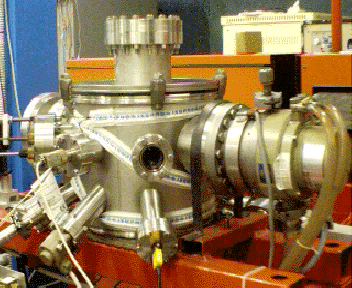
View of the deposition chamber
for multilayer fabrication
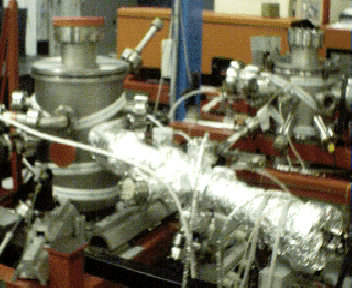
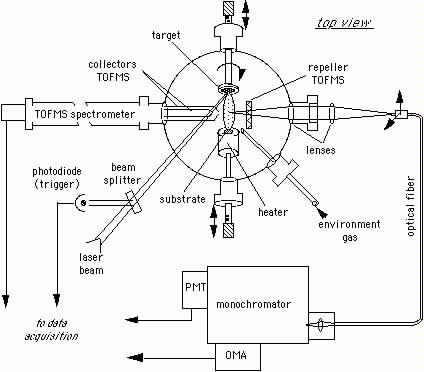
View of the deposition chamber
for in-situ diagnostics (equipped with TOFMS)
Main experimental
facilities available in the laboratory are:
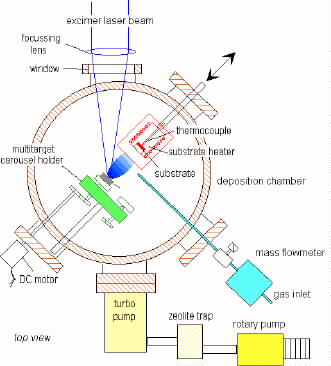
an excimer laser LambdaPhysik
EMG101MSC operated with XeCl mixture (308 nm, 120 mJ, 16 ns);
a deposition
chamber (base pressure ~ 10-8 mbar) equipped with a multitarget
holder for sequential ablation of up to 4 different targets and a stainless
steel substrate heater (Tmax 900 °C in oxygen atmosphere
(at p(O2) around 0.4 mbar), stability 1 °C;
a J-Y HR640FSL monochromator
with gateable OMA (PAR IRY 1000G/B/R) for time and space-resolved analysis
of the plume optical emission;
a 70 cm home-made Time-Of-Flight
Mass Spectrometer (TOFMS) with cw and pulsed operation for time and space-resolved
analysis of the primary ion content of the plume;
a laser-diode based
system for time and space-resolved optical absorption measurements of atomic
and molecular oxygen during PLAD
various optical, electronics
and optoelectronics devices and PC-controlled instrumentation for carrying
out the diagnostics measurements.
Characterization of
our thin films and multilayers is mostly based on collaborations we have
with other groups operating in the field of materials science. Anyway,
in our lab we can perform preliminary optical (space-resolved reflection
and transmission meaurements) and electrical (four probe resistance vs
temperature) analysis on our samples. In addition, we fully exploit the
capabilities of the Scanning
Probe Microscopy Laboratory of Prof. Maria Allegrini to investigate
the morphology and the optical properties of our samples with a space resolution
below the diffraction limit.